Domestic Dog

Dogs were probably the first tame animals.

African Wild Dog

The African wild dog, also called Cape hunting dog or painted dog, typically roams the open plains and sparse woodlands of sub-Saharan Afri...

Dingo

Dingoes, though generally associated with Australia, likely originated from Southeast Asia and were introduced to Australia about 3,000 yea...

Hiển thị các bài đăng có nhãn animal. Hiển thị tất cả bài đăng

Thứ Hai, 21 tháng 11, 2016

Porpoises facts you may have never heard of

Right here in this article, you can learn about all your favourite mamals, and even some you may have never heard of Porpoises

  • Porpoises are among the smallest aquatic mammals. Check out my list of fun, weird and just plain amazing fact of life I have found.
  • They are related to dolphins and whales and belong to the same order, Cetacea.
  • They are very similar looking to the dolphin. However, the way to distinguish them generally is from: their smaller size; they have a rounder body shape and they lack the ‘beak’ of the better known dolphins.
  • There are six species of porpoise.
  • Different types of porpoises include the Common or Harbour porpoise, which is dark coloured on back and white underside, for camouflage in coastal waters and is similar to the Californian porpoise; Dall’s porpoise, which has a slightly more muscular body, they are jet black on back with white patches on the belly and flanks; Burmeister’s porpoise, which is dark overall, the Dorsall (back) fin has a sharp point with ‘teeth’ on its leading edge; Finless porpoise, which are grey overall, except for paler throat and face, they have a rounded, blunt head and no dorsal fin; the Spectacled porpoise, which is blue-black on back and white on sides and under-parts, they have a rim around their eyes which resemble spectacles. That might be one of the most awesome interesting facts ever.
  • Porpoises are thought to have emerged as a group of aquatic mammals about 15 million years ago, when they were confined to the north of the Pacific Basin. From these beginnings they slowly evolved into the total of six species of porpoise alive today.
  • They are sociable creatures and are often found in groups of 2-20, but usually about 4.
  • They are sexually mature by the age of 4-7 years, according to the species. mating season is summer in the northern hemisphere. Gestation is 11-12 months and they have 1 young.
  • Young calfs are born half the length of the female and has to be brought to the surface immediately to take its first breath. The female often swims on her side as she suckles her young calf. In this way they reach the water’s surface to breathe at the same time. This only happens in the first few days after birth, and soon the calf surfaces independently and dives to resume feeding. The young often remain with its mothers after being weaned.
  • The Dall’s porpoise is known to be the fastest of all the porpoises. It powers through the water at speeds of 20-30km/h. It is also famous for its ‘rooster’ spray – a stream of water that arcs up over the head as it reaches the water’s surface. They are the most sociable and are attracted to moving ships.
Image result for Porpoise
  • The Finless porpoise, as its name suggests, has no dorsal fin. The females have been known to carry her single young, or calf, on her back as on a saddle.
  • Porpoises have between 60-120 teeth which are flattened into a spade shape at the tip.
  • The common porpoise makes a distinctive, explosive noise as it comes to the surface to exhale.  It has also been called a ‘puffin pig.
  • Similar to the dolphin, the porpoise have a wide repertoire of communication calls, including ‘clicks’ used for echo-location. That might be one of the most awesome animals facts you had no idea before.
  • Their greatest threat to population is fishing nets and pollution. Some species are thought to be declining as a result. 
  • Another hazard of inhabiting coastal waters for the common porpoise is that it can get stranded on beaches.

Thứ Tư, 16 tháng 11, 2016

Top 9 awesome facts on Moose

This writing is so amazing. I just wanna all of you can enjoy top 9 awesome facts on Moose . Keep seeing to enjoy!

1. MOOSE ARE HUGE.


Moose are the largest members of the deer family, weighing as much as 1200 pounds; they can grow to be 5 to 6.5 feet from hooves to shoulders. This does not include a raised head or antlers, so it's safe to say that the majority of moose tower over all non-basketball players. 
Enjoy our wide range of funny pictures with captions that can make a joyful day.

2. THEY EAT A LOT.


With huge size comes a huge appetite. Moose are browsers and will casually devour 73 pounds a day in the summer and 34 pounds in the winter. They eat an assortment of shrubs, woody plants, and aquatic vegetation; in the winter, their diet is more restricted, so they eat the buds of plants.

3. ORGANISMS OF ALL SIZES POSE A THREAT TO MOOSE.


Moose are formidable opponents with sharp hooves that can kick with tremendous force, but even they have predators. A pack of wolves or a black bear is no match for a healthy adult moose, so bears and wolves typically pick off the young, sick, and old. And even though moose are powerful and quite large, a single bite can do one in: There's a good chance the bite will cause an infection that eventually kills the animal up to two weeks later. 

Moose also have a much smaller menace to worry about: parasites. Brain worm (Parelaphostrongylus tenuis) is a parasite contracted from eating snails. The infectious larvae migrate to the moose's brain and cause neurological damage. "It’s interesting thinking of something as big as a human hair killing a 1200 pound moose, but they do," Carstensen says. 

Another tiny nuisance is the winter tick. Tick infestations depend on the weather and habitat: Harsh winters mean less ticks the following year; when ticks fall off animals to complete their cycle and there's still snow on the ground, they die. So hard, long winters are great news for moose. 

4. THEIR ANTLERS ARE USED FOR FIGHTING...


When fighting off predators, the antlers, or paddles, don't come into play as much as you would think; a moose's first line of defense is its sharp hooves, which are capable of mortally wounding a wolf or bear.

Paddles are only found on males, and used mainly for fighting and displaying. During mating season in autumn, bulls will cover a lot of ground looking for females to mate with. They establish breeding territory by fighting off other males in the area. The fights are not always fight-to-the-death scenarios, and often a competing moose will back away from a fight if the challenger has a more impressive rack of antlers. Great paddles are not the only way to find mates; some males with better navigational skills—or just sheer luck—may come across a female by chance and completely skip antler combat. 

5. ...AND THEY SHED EVERY YEAR.


Moose lose their paddles every winter and grow new ones the following spring. "Antler growth is based on testosterone levels and day length," Carstensen says. "So they start to grow those antlers in the late spring and summer, and they’re covered in velvet. The velvet is vascularized so there is a blood-flow supplying these antlers as they’re growing." By early fall—a.k.a. mating season—bulls start to shed and shine their paddles by rubbing them against trees. Their fuzzy velvet-covered antlers go through a gory transformation, and by October they will have shiny new paddles for competition and display. 

Antlers are also a great indicator of age. With each winter, young moose paddles grow in size: nubs become spikes and spikes become full racks. Bulls in their prime, between ages 5 and 8, have the largest racks. With old age, the antlers become more deformed and less impressive. 

6. ANTLERS ARE HEAVY. 


Just like the moose themselves, antlers can come in different sizes. The paddles are essentially a big bone, so they generally weigh quite a bit; bulls develop muscular necks to help hold up the enormous paddles. A full grown moose's antlers can weigh about 40 pounds. Anyway, this may be one of the most fascinating animal facts until now.

7. THE BABIES NEED HELP FROM THEIR MOM.


Female moose, or cows, generally have 1 to 2 calves in May. On average, the calves weigh about 30 pounds at birth and grow very quickly. Still, baby moose don't have the ability to run or protect themselves very well, so the mother stays with her offspring for a year and a half, fighting off wolves and bears that try to pick off the young calves.

8. THEY'RE GREAT SWIMMERS.


Moose are naturally gifted swimmers. It's common to see one hop right into a lake and swim across at up to 6 mph. The animals have an innate ability to know how to swim, so even calves can swim. 

9. THERE ARE FOUR SUBSPECIES IN NORTH AMERICA.


Moose can be categorized into four different species in North America: the eastern moose (A. alces americana), the Shiras moose (A. alces shirasi), the Alaskan moose (A. alces gigas), and the northwestern moose (A. alces andersoni), which Carstensen works with in Minnesota. Moose can be distinguished by different sizes and antler shapes. The largest moose is the Alaskan moose (pictured above) that can stand at 7 feet tall with an antler span of 6 feet. 

10. THEY'RE DYING AT AN ALARMING PACE.


Something is happening to all the moose in Minnesota. The state once had a flourishing moose population in the north that was hunted and doing quite well: In the mid-1980s, there were 2000 of the animals in the northwest, but that number dropped to less than 200 in just two decades. This prompted the state to do some research to prevent further drops in population. Unfortunately, the northeast is now facing similiar a problem; the moose population has dropped 50 percent since the mid-2000s.

Learn all valuable information you wanted about science facts via our articles.

Chủ Nhật, 13 tháng 11, 2016

How many facts did you know about Greater Bilby?

How many facts did you know about Greater Bilby?


Greater bilbies are commonly known as bilbies due to the lesser bilby now being extinct. They are marsupials found only in Australia and are also called rabbit-eared bandicoots. The Easter Bilby is an Australian alternative to the Easter Bunny.

Facts About Greater Bilby 
  • The greater bilby comes from the family of marsupials known as bandicoots. It is the largest among all the members of the family.
  • According to the AustralianNationalUniversity, the animal has derived its name from an aboriginal language ‘Yuwaalaraay’.
  • Its black coloured eyes, nearly 1 centimetre in diameter, do not make clear vision. Due to the poor vision, it solely relies on its strong sense of hearing and smell. The eyes are protected with the help of fine black eyelashes. This is one of the most interesting facts about Greater Bilby ever. 
  • Built of a greater bilby comprises of long pointed nose, large hairless ears, white underside, black tail with a white crest. Because of its large ears, it is also known as Rabbit-Eared Bandicoot.
  • The large ears of bilby aid in its effective hearing, as well as, strive to regulate its body temperature. They are also exceptionally manoeuvrable and can be rotated, made to stand flat against the body, positioned at right angles to the body and can even be folded in half.
  • The soft and silky fuzz of bilby is primarily of pale blue-grey colours, with white and cream coloured undersides and feet.
  • The stretched nose with hairless pink tip gives bilby an ability to smell sharply and smartly. You can witness many long, dark fuzz stick out from either side of the snout.
  • A bilby has long slim tongue and 48 teeth: 26 on upper jaw and 22 on lower.
  • It has slightly curved claws on the toes of its front feet. Whereas, on the feet of its hind legs, the second and third toes have slight joints with much larger fourth toe.
Image result for Greater Bilby
  • Its claws and front legs are very strong which help it dig for its food and make deep burrows. An expert in digging, a bilby can dig up to a dozen of burrows. These burrows are generally spiral and as much as 3 meters deep.
  • When a female bilby digs the soil, the dirt does not fill in its pouch as the pouch of a bilby opens in backward direction.
  • The weight of an adult male bilby can go up to 2.5 kg. The weight of adult female bilby on the other hand, is significantly less (sometimes half) than that of an adult male.
  • These are the nocturnal creatures that came out of their burrows nearly an hour after sunset and often go back in their burrows before first rays of the sun.
  • The tail of a bibly is divided into three distinct sections: in the begining for a few centimetres, the colour of the tail resemble blue-greyish colour of the body; the middle section of the tail is black coloured, and at the end the tail is white.
  • Bilby is a solitary animal, which prefers to roam alone. Although sometimes, bilbies are also seen in groups with at the most four members.
  • Given that there is sufficient rainfall and food is available to them, bilbies can breed throughout the year. Let’s discover some interesting science facts that will amaze you.
  • Having the smallest gestation period of all the mammals, greater bilbies breed one to three young bilbies in a litter.
  • Infant bilbies remain in the pouch of their mother for nearly 80 days. It takes further 2 weeks till they become independent.
  • Bilbies are the omnivorous creatures. Their food ranges from seeds, fruits, fungi to spiders, bulbs, small animals, insects and their larvae.
  • A greater bilby consumes significant amount of mud along with its food.
  • Bilbies do not drink water; rather, their food provides them with the requisite level of water to survive.
  • Previously, they were hunted by Australians for food and fur. Other than humans, today they are preyed by foxes and feral cats.
  • Before the European settlement, nearly 70% of the Australian Mainland had bilbies.
  • At present, they are mostly seen in the south-west Queenslandand secluded parts of Western Australiaand the Northern Territory.
  • The isolations of each of their colonies make them even more susceptible to diseases and inbreeding.
Are you bored? Let’s have a quick look at our funny images that are bound to bring smile on your face.

10 of the most interesting facts on Gibbon

Check out below 10 of the most interesting facts on Gibbon right here


Gibbon is a small ape. Its closest relatives are gorilla, chimpanzee, orangutan and bonobo. There are 15 species of gibbons that can be found in Southeast Asia (China, India, Burma, Malayan peninsula, Borneo…). Gibbon lives in dense jungles and tropical rainforests.

Gibbon facts
  1. Gibbons spend almost all of their time in the treetops of the rainforest. They even sleep there, resting in the forks of branches.
  2. Their dramatic form of locomotion, called brachiating, can move gibbons through the jungle at up to 35 miles (56 kilometers) an hour, bridging gaps as wide as 50 feet (15 metres) with a single swinging leap.
  3. Because they are not able to swim, different types of gibbons are isolated in different areas by large rivers.
  4. When gibbons walk, whether along branches or in the rare instances when they descend to the ground, they often do so on two feet, throwing their arms above their head for balance.
  5. They are the most bipedal of all non-human primates and are often studied for clues to what evolutionary pressures may have led to human walking.
  6. There are 15 recognized species of gibbons ranging from northeastern India to southern China to Borneo. Let’s discover some interesting science facts that will amaze you.
  7. Gibbons are omnivores (they eat both plants and animals). Their diet consists mainly of fruit, but they also eat different types of seed, shoots, flowers and insects.
  8. Gibbons live in family groups composed of breeding couple and their offspring. Gibbons are monogamous (one couple mate for life) and they form very strong bonds with family members. Grooming plays important role in their social life.
  9. Gibbons are territorial animals that usually live on a territory of 25 to 40 hectares. They fiercely defend their home.
  10. Gibbons are highly intelligent animals. They can recognize themselves in the mirror. Also, they are able to communicate via various songs. Songs usually last 10 to 30 minutes and both males and females perform them. Main purpose of the song is to announce presence of the group on a certain territory.
Are you bored? Let’s have a quick look at our funny images that are bound to bring smile on your face.

Thứ Năm, 10 tháng 11, 2016

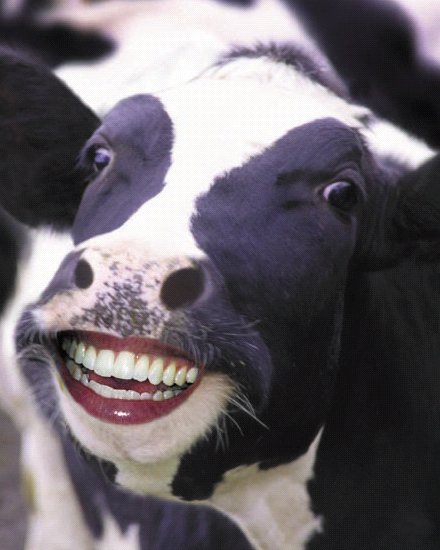
Top cool facts you never knew about Cows

Check out our range of interesting facts about Cow for kids. Learn the world population of cattle, what young cows are called, what they eat and much more.

  1. In deep mud, cows can run faster than horses!
  2. A cow has one stomach with four compartments. The rumen, reticulum, omasum and the abomasum.
  3. Cow are ruminates meaning they can digest food that can normally not be digested.
  4. Like a human’s fingerprints, no two cow’s spots are exactly the same.
  5. A cow is pregnant for nine months. A calf is about 90 pounds when it is born.
  6. Cows have an excellent sense of smell. They can smell up to 5 miles away!
  7. Cattle are herbivores that eat vegetation such as grass.
  8. Cattle stomachs have four chambers which help break down what they eat
  9. There are well over 1 billion cattle in the world.
  10. Cattle are sacred in India.
  11. There are an estimated 300 million cattle in India.
  12. Young cattle are generally known as calves.
  13. Like many other grazing animals cattle have one stomach which is divided into four compartments or chambers: the rumen, reticulum, omasum and abomasum. This allows them to digest grain and grasses most effectively.
  14. Cattle have almost 360° panoramic vision. This helps them to see predators coming from any direction. Enjoy the best collection of animals facts on our site to widen your knowledge.
  15. Cattle have an excellent sense of smell. They can detect odours up to five miles away. They can also hear both low and high frequency sounds beyond human capability.
  16. The cow is a protected animal in Hinduism, and Hindus do not eat beef. Cows are honoured at least once a year, on Gopastami. On this day cows are washed and decorated in temples.
  17. Mahatma Ghandi described a cow as “a poem of compassion”, also stating that “I worship the cow and I shall defend its worship against the whole world”.
  18. The meat of cows is widely eaten by people across the world. Cows' milk is also drunk and used to make other products such as cheese. Many people who consume animal products would like to choose products from animals kept in higher welfare systems. However welfare labelling on products can be confusing. 
  19. Adult females are generally called cows.
  20. Adult males that are not castrated are generally called bulls.
  21. Cattle are red/green color blind.
  22. In the sometimes controversial sport of bull fighting, bulls are angered by the movement of the cape rather than its red color.
  23. Cattle are farmed for a number of agricultural products including meat and dairy products.
If you’re looking for the most interesting tigers facts, you’re at the right place. Let’s check out now.

Thứ Ba, 13 tháng 9, 2016

Tigers are hunted

Reading and enjoying these following facts about fact: Tigers are hunted


For more facts: tiger facts for kids
Tigers are killed for body parts used in traditional medicines. The biggest threat facing Amur tigers is habitat loss due to logging. As they lose habitat, they lose prey, which means they sometimes turn to domestic livestock for food. This makes them unpopular with ranchers, who may shoot them as pests.

And tigers are killed for other reasons: they're hunted for their meat and skins as well as their bones, which are used in traditional Chinese medicine. Poaching of tigers has become an increasing problem in recent years, and it's taking a heavy toll on these mighty cats.

Most Siberian tigers are killed for export to China. As a member of CITES, the People's Republic of China (PRC) is (allegedly) committed to stopping the illegal trade of animals, such as tigers, and consequently the decline of their population. However, tiger products are in evidence in China. The State Council of the PRC however reported that existing stockpiles of tiger derivatives in China were obtained before China joined CITES.

Tigers are falling prey to unscrupulous hunters who are indiscriminately killing them for measly amounts on the behest of bigger fishes. The sad part is the protectors of tigers have become hand in glove with the poachers in killing one of the magnificent creations of GOD. The main reason behind killing the magnificent beast is two folds. The first being feeding the insatiable hunger of especially the Chinese in supplying tiger body parts for so called medicinal purpose. They are supposed to produce medicinal products out of the tigers.

The second part is many a degenerated souls put up a cowardly act of putting on tiger skin adorned garments to pump up their ego. In India many tigers have been poached to satisfy the Tibetans who wear them as traditional dresses. Recently His holiness the Dalai Lama has issued a decree against it. You may be shocked to know that recently in India one national tiger reserve (Sireska) was found to be devoid of tigers as all had been poached. To cut short at this rate of tiger culling our next generation may not be able to look at tigers in real life but in photos only. As some one said the tiger is hemorrhaging, unless we get up & do something positive about it it may be gone for ever.
Also see elephant facts

Image result for why tigers are hunted

They are only being killed illegally, Tigers are a protected species, and it is illegal to import any part of them into the UK, however, we in the UK have no say in what goes on in other countries, the ban is world wide and introduced by the UN but there are many curative properties attributed, but not correctly, to products from Tigers and other strong animals such as Lion and Bear. Many primitive cultures, and others not so primitive, believe that eating part of a tiger would mean the person absorbs some of its strength and courage.

Some people feel the fur is an exotic type of clothing. Or a fancy rug. What they don't realize is that they wouldn't be very happy if some animal used a person's skin in the same way (sorry if that's a bit graphic). This makes me especially sad, because I work with tigers, and they're my favorite animal.
Read more  animal facts

Thứ Tư, 31 tháng 8, 2016

Why are giraffes so tall?

Reading and enjoying these following facts about why are giraffes and baby giraffe get so long neck

Around 15 million years ago, antelope-like animals were roaming the dry grasslands of Africa. There was nothing very special about them, but some of their necks were a bit long.

Within a mere 6 million years, they had evolved into animals that looked like modern giraffes, though the modern species only turned up around 1 million years ago. The tallest living land animal, a giraffe stands between 4.5 and 5 metres tall – and almost half that height is neck.

Most people assume that giraffes’ long necks evolved to help them feed. If you have a long neck, runs the argument, you can eat leaves on tall trees that your rivals can’t reach. But there is another possibility. The prodigious necks may have little to do with food, and everything to do with sex.

The evidence supporting the high-feeding theory is surprisingly weak. Giraffes in South Africa do spend a lot of time browsing for food high up in trees, but elsewhere in Africa they don’t seem to bother, even when food is scarce.
Girls like them long

Giraffes’ necks are long, but there have been longer ones. Sauropod dinosaurs trump them easily: the dinosaur Mamenchisaurus, for instance, had a neck over 9 metres long, four times the longest of giraffe necks.

Long necks come at a cost. Because a giraffe’s brain is around 2 metres above its heart, the heart has to be big and powerful. In fact, for the blood to reach the brain it has to be pumped at the highest pressure of any animal. So there must be a big payback to keep giraffes’ necks so long.

The latest theory – and it’s a surprise this hasn’t come up before, given biologists’ fixation with it – is that the long necks are the result of sexual selection: that is, they evolved in males as a way of competing for females.

Kết quả hình ảnh cho Why are giraffes so tall?

Male giraffes fight for females by “necking”. They stand side by side and swing the backs of their heads into each others’ ribs and legs. To help with this, their skulls are unusually thick and they have horn-like growths called ossicones on the tops of their heads. Their heads, in short, are battering rams, and are quite capable of breaking their opponents’ bones.

Having a long and powerful neck would be an advantage in these duels, and it’s been found that males with long necks tend to win, and also that females prefer them.

The “necks for sex” idea also helps explain why giraffes have extended their necks so much more than their legs. If giraffes evolved to reach higher branches, we might expect their legs to have lengthened as fast as their necks, but they haven’t.
Also see elephant facts

Neck and neck

The problem for the sex idea is that it implies that female giraffes shouldn’t have long necks, and they plainly do. Sexual selection often drives males to develop spectacular attributes – think peacocks’ tails or the feathers of birds of paradise – to impress females, but the females remain relatively dowdy.

A study last year by Graham Mitchell of the University of Pretoria in South Africa and colleagues apparently delivered a knock-down blow to the “necks for sex” theory. Mitchell’s team showed that, in Zimbabwe at least, males and females had necks that were almost exactly the same length, and that if anything the females’ necks were longer. This led many people to write off the whole sex idea.

However, Rob Simmons and Res Altwegg of the University of Cape Town, also in South Africa, have taken a second look at Mitchell’s results and are not convinced. They say the figures do show that males have proportionally longer necks, and that “Mitchell et al. appear to have misinterpreted this result”.

Kết quả hình ảnh cho Why are giraffes so tall?

They point to a study in Namibia which found that males consistently had heavier necks than females with the same body mass, and that only the males’ necks kept growing throughout their lives. Males’ heads were also heavier than females’, which is what you would expect if they were being selected for their ability to fight.

Simmons and Altwegg suggest that giraffes’ necks may have begun growing as a way of eating hard-to-reach food, but that they were then “hijacked” for mating purposes. Once the necks had reached a certain length, males could use them for necking and clubbing – and at that point sexual selection took over, driving the necks to their current extreme lengths.

Peacocks and birds of paradise aside, there are many birds of which the male seems to have developed colourful plumage as a result of sexual selection, but the females are also brightly coloured. Perhaps the sexual selection explanation for long necks in giraffes isn’t dead after all.

You might be like to see interesting animal facts

Thứ Hai, 29 tháng 8, 2016

Tigers can climb trees

Don't you know why and when do tigers climb trees? Just keep reading to know more about this tigers facts

Although able to climb trees, tigers rarely climb trees; they can easily reach 500 pounds, which is far too heavy for efficient climbing. Tiger cubs have been seen going up and down trees for fun, but they do so less as they grow larger. 
Mostly, tigers avoid climbing trees because they don't always know how to get down, which leads to very awkward situations.

Cubs:

Kết quả hình ảnh cho does tiger climb tree

Tiger cubs willingly climb trees for about the first sixteen months of life and young tigers have been sighted following langur monkeys up into the trees in an effort to secure a feed. But after this age their increasing weight makes both ascent and descent difficult, and few tree branches have the needed strength to hold their weight.
Also see elephant facts

Adults:

Adults seldom climb, but are quite capable of doing so; they may do this if being chased by dogs or when after prey. There have been occasions of men climbing trees to escape an attacking tiger, only to be killed when the tiger followed them up. 
This does not mean tigers are willing or efficient climbers. On the contrary, they are not. The white Bengal and Amur tigers shown here are doing something quite unusual for tigers of their age.

Chủ Nhật, 21 tháng 8, 2016

Dragons have been discovered in our times

Whether or not dragons exist, they have been discovered in our times. Keep reading for more amazing animal facts about dragons:


This species has many features similar to the legendary dragons we’ve heard about. It is capable of gliding flight, it is carnivorous being a reptile and it lays eggs. The recorded maximum length of this species is around 23 cm, now that’s a bit low for dragons right?

Well perhaps there are some secrets still left to be discovered, like may be it was evolution or even magic that got all dragons to shrink !


No this species doesn’t breath fire either but then again it might be choosing not to ? or perhaps the decrease in size has rendered it incapable of fire, probably due to decreased intelligence. The possibilities are endless.

Learn more funny random facts. 

Thứ Năm, 18 tháng 8, 2016

Animal question: Can cockroaches fly?

Can you answer animal facts question: Can cockroaches fly?


To answer your question simply, yes.

The very thought of cockroaches can send shivers down your spine. These pesky creatures are synonymous with dirt and filth, and are also known to spread diseases such as salmonella, whilst also triggering asthma.

There are around 4,500 species of cockroaches in the world, but only 30 are considered pests. But can these crawling insects fly?
Can cockroaches fly?

One thing that might not have crossed your mind (or maybe it has) is if cockroaches can fly. Well you may be shocked to find out that they can, in fact, fly.
Do all cockroaches fly?

Although a handful of cockroach species have wings, the majority of them aren’t good flyers, or can’t fly at all. On the other hand, some are strong, capable fliers whilst others just glide from one spot to another, and only for a short period of time.

For more facts of life

Some basic infor about penguins

Enjoying these following penguin facts about their living place, diet and mating and baby penguins

Where do penguins live?


Considered marine birds, penguins live up to 80 percent of their lives in the ocean, according to the New England Aquarium. All penguins live in the Southern Hemisphere, though it is a common myth that they all live in Antarctica. In fact, penguins can be found on every continent in the Southern Hemisphere. It is also a myth that penguins can only live in cold climates. The Galapagos penguin, for example, lives on tropical islands at the equator.

What do penguins eat?

A penguins diet consists primarily of fish, squid and krill.

Depending on the species of penguin their food preference can vary which also helps reduce competition for food.

Large colonies are able to consume millions of pounds of food on a daily basis.

Penguins rely on their eyes to find food while underwater.

Most dives for food do not exceed 60 feet, although some species are capable of diving nearly 2,000 feet for when hunting for prey.

They capture their prey by grabbing it with their bill and swallow their food whole.

Penguins are known to fast (stop eating) annually during breeding periods when they must watch their eggs, keep them warm and prevent them from being attacked by predators.

Before fasting they stock up by consuming large quantities of food so that they can build up enough energy from fat to last them throughout their fasting period.

Mating and baby penguins


A group of penguins is called a colony, according to the U.S. Geological Survey. During breeding season, penguins come ashore to form huge colonies called rookeries, according to Sea World.

Most penguins are monogamous. This means that male and female pairs will mate exclusively with each other for the duration of mating season. In many cases, the male and female will continue to mate with each other for most of their lives. For example, research has found that chinstrap penguins re-paired with the same partner 82 percent of the time and gentoo penguins re-paired 90 percent of the time.

At around three to eight years old, a penguin is mature enough to mate. Most species breed during the spring and summer. The male usually starts the mating ritual and will pick out a nice nesting site before he approaches a female.

After mating, the female emperor or king penguin will lay a single egg. All other species of penguins lay two eggs. The two parents will take turns holding the eggs between their legs for warmth in a nest. The one exception is theemperor penguin. The female of this species will place the egg on the male's feet to keep warm in his fat folds while she goes out and hunts for several weeks.

When penguin chicks are ready to hatch, they use their beaks to break through the shell of their eggs. This process can take up to three days. After the chicks emerge, the parents will take turns feeding their offspring with regurgitated food. Penguin parents can identify their offspring by unique calls that the chick will make.

Read more: animal fun facts

Thứ Tư, 17 tháng 8, 2016

Top 15 elephant fun facts

Check out our awesome range of elephant facts for kids with Top 15 elephant fun facts


  1. Elephants have no natural predators. However, lions will sometimes prey on young or weak elephants in the wild.
  2. The main risk to elephants is from humans through poaching and changes to their habitat.
  3. The street value of elephant ivory is now greater than gold, running to tens of thousands of pounds per tusk.
  4. One of the most interesting types of Elephant is the African elephant. It has the scientific name of Loxodonta africana of Africa. The look of this animal is different with the Asian African elephants.
  5. More than 20,000 African elephants were slaughtered in 2013, according to the Convention on International Trade in Endangered Species of Wild Fauna and Flora.
  6. The Kenya Wildlife Service has documented the killing of 97 elephants so far this year.
  7. But according to Dr. Paula Kahumbu, who leads the Hands Off Our Elephants campaign, elephant poaching in Kenya is at least 10 times the official figure.
  8. The animal is considered as the four legged herbivorous mammal that has grey color with large body size. There are two fingers located oat the tips of the trunk. The ears come in fan shape.
  9. Poachers in Kenya have enjoyed lenient sentences and few have been successfully prosecuted.
  10. A study by WildlifeDirect found that over the past five years just 4% of those convicted of wildlife crimes were sent to jail.
  11. New legislation passed earlier this year that should lead to higher conviction rates and tougher sentences.
  12. The global ivory trade was worth an estimated $1 billion over the past decade, with 80% of ivory from illegally killed elephants.
  13. We need to call the elephant with the right name. If you want to call a baby elephant, use the word a calf. The adult female is called as a cow, while a bold is used to call an adult male elephant. A herd is used to call a group of some elephants.
  14. The total global elephant population is currently estimated at 650,000, and they are very much in danger of extinction.
  15. Organisations working to protect elephants include Born Free, Save the Elephants, Space for Giants, and Tsavo Trust (The trust protects the land where Satao lived, and they need all the help they can get. Please consider donating.)

Thứ Ba, 16 tháng 8, 2016

Tiger - Where do they live?

Reading and enjoying these following tiger facts -  facts of one of the most amazing big cats in the world.

Tigers are found in amazingly diverse habitats: rainforests, grasslands, savannas and even mangrove swamps. Unfortunately, 93 percent of historical tiger lands have disappeared primarily because of expanding human activity. Saving tigers means saving forests that are vital to the health of the planet. You can help by taking action to save tiger forests.


In many areas, the number of tigers is dwindling due to poaching and loss of habitat, and the reproduction rate of tigers is not high. A female typically produces two to three cubs every 2 to 2 1/2 years, because cubs are not fully independent until they are about 2 years old. About one-half of all cubs do not survive long enough to go out on their own. Females are ready to reproduce at 3 to 4 years old, but males do not first mate until they are 4 or 5.


Thứ Sáu, 12 tháng 8, 2016

The most fascinating and mysterious owl facts

Owls are some of the most fascinating and mysterious raptors in the world. Those who love animal facts will not want to skip the following facts about this amazing animal:


  1. Barn Owls eat mostly voles, shrews, mice and sometimes rats.
  2. Food is often swallowed whole – bits of fur and bone are then regurgitated (coughed up) as an owl pellet.
  3. Barn Owls screech – they never hoot (that’s Tawny Owls).
  4. The scientific Latin name for Barn Owl is Tyto alba alba.
  5. Barn Owls have very long legs, toes and talons to help them to catch prey hidden under long grass.
  6. Most owls hunt insects, small mammals and other birds.
  7. Some owl species hunt fish.
  8. Owls have powerful talons (claws) which help them catch and kill prey.
  9. Owls have large eyes and a flat face.
  10. Owls can turn their heads as much as 270 degrees.
  11. Owls are farsighted, meaning they can’t see things close to their eyes clearly.
  12. Owls are very quiet in flight compared to other birds of prey.
  13. The color of owl’s feathers helps them blend into their environment (camouflage).
  14. Barn owls can be recognized by their heart shaped face.
  15. Barn Owls usually hunt at night – even in total darkness they can find the smallest vole using their super-sensitive hearing.
  16. Barn Owls’ large eyes are very sensitive too – they can quickly spot a mouse moving in a very gloomy barn.
  17. Barn Owl feathers are super soft – this helps them to hunt silently, but they are not very waterproof and get soaked if it rains.
  18. Barn Owls have lop-sided ears! One is higher than the other, which helps them to pinpoint exactly where tiny sounds are coming from.
  19. A wild Barn Owl usually eats about 4 small mammals every night, that’s 1,460 per year!

Thứ Năm, 11 tháng 8, 2016

What are the pig facts?

Reading and enjoying these following animal facts about pigs

pigs are smart

  • Pigs snuggle close to one another and prefer to sleep nose to nose. They dream, much as humans do. In their natural surroundings, pigs spend hours playing, sunbathing, and exploring. People who run animal sanctuaries for farmed animals often report that pigs, like humans, enjoy listening to music, playing with soccer balls, and getting massages.
  • Pigs communicate constantly with one another; more than 20 vocalizations have been identified that pigs use in different situations, from wooing mates to saying, “I’m hungry!”
  • Newborn piglets learn to run to their mothers’ voices and to recognize their own names. Mother pigs sing to their young while nursing.
  • According to Professor Donald Broom of the Cambridge University Veterinary School, “[Pigs] have the cognitive ability to be quite sophisticated. Even more so than dogs and certainly [more so than human] 3-year-olds.”
  • Think that pigs are slow and lumbering? As it turns out, they’re not at all! Adult pigs can run at speeds of up to 11mph, or in other words, they can run a seven-minute mile. Could you do any better?
  • Pigs appear to have a good sense of direction and have found their way home over great distances. Adult pigs can run at speeds of up to 11 miles an hour.


pigs-exploring

  • Like humans, pigs are omnivores, meaning they eat both plants and other animals.
  • A pig’s snout is an important tool for finding food in the ground and sensing the world around them.
  • Pigs have an excellent sense of smell.
  • There are around 2 billion pigs in the world.
  • Humans farm pigs for meat such as pork, bacon and ham.
  • Pigs do not “eat like pigs” or “pig out.” They prefer to eat slowly and savor their food.
  • Suzanne Held, who studies the cognitive abilities of farmed animals at the University of Bristol’s Centre of Behavioural Biology, says that pigs are “really good at remembering where food is located, because in their natural environment food is patchily distributed and it pays to revisit profitable food patches.”
  • Pigs are clean animals. If given sufficient space, they will be careful not to soil the area where they sleep or eat. Pigs don’t “sweat like pigs”; they are actually unable to sweat. They like to bathe in water or mud to keep cool, and they actually prefer water to mud. One woman developed a shower for her pigs, and they learned to turn it on and off by themselves.

Thứ Tư, 10 tháng 8, 2016

Tiger facts for your kids

Learn animal facts and all information you wanted about tiger facts for kids by this article:

Kết quả hình ảnh cho tiger facts for kids

  1. The tiger is capable of killing animals over twice its size; it is one of nature’s most feared predators.
  2. Like its ancestor, the sabre-tooth cat, the tiger relies heavily on its powerful teeth for survival. If it loses its canines (tearing teeth) through injury or old age, it can no longer kill and is likely to starve to death.
  3. Tigers live alone and aggressively scent-mark large territories (up to 100sq km in size) to keep their rivals away.
  4. They are powerful nocturnal hunters that travel many miles to find buffalo, deer, wild pigs, and other large mammals. A Bengal tiger can eat 21kg of meat in a night and can kill the equivalent of 30 buffaloes a year.
  5. The roar of a Bengal tiger can carry for over 2km at night.
  6. Although tigers are powerful and fast over short distances, the Bengal tiger cannot outrun fleet footed prey such as deer. Instead it uses stealth to catch its victims; attacking from the side or the rear.
  7. Tigers use their distinctive coats as camouflage (no two have exactly the same stripes).
  8. If the kill is large, the tiger may drag the remains to a thicket and loosely bury it with leaves, then return to it later.
  9. As well as game animals, it preys on wild boar, monkeys, lizards and occasionally porcupines.
  10. Females give birth to litters of two to six cubs, which they raise with little or no help from the male. Cubs cannot hunt until they are 18 months old and remain with their mothers for two to three years, when they disperse to find their own territory.
  11. Like domestic cats, all tigers can purr. Unlike their tame relatives, however, which can purr as they breathe both in and out, tigers purr only as they breathe out.
  12. Unlike other cats, tigers are good swimmers and often cool off in lakes and streams during the heat of the day.

Also see: penguins facts for kids